Categories
Home Buying Tips, New Construction, VA Loans, Coastal Georgia Homes, Military Relocation, Buyer GuidesPublished August 4, 2026
Builder Incentive or Lower Sales Price: Which One Saves Coastal Georgia Buyers More Money?

Written by Kevin Thomas
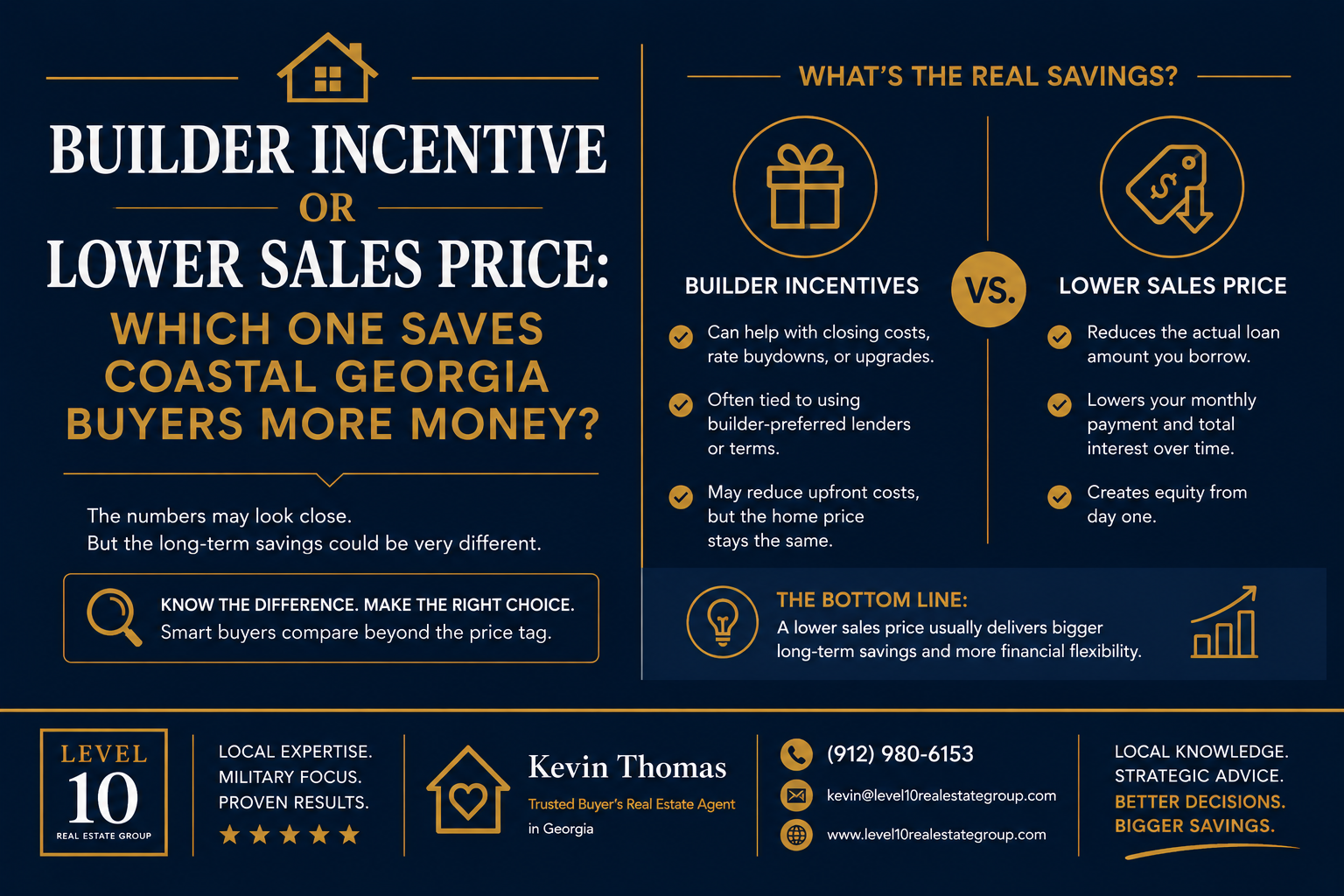
Every new construction buyer in Coastal Georgia eventually gets offered a choice: take a builder incentive, or ask for a lower sales price instead. Most buyers assume these are roughly equivalent — a dollar is a dollar. They aren't, and the difference can add up to real money over the life of your loan.
👉 A builder credit applied to a permanent rate buydown often lowers your monthly payment more than the same dollar amount taken off the purchase price — even though your loan balance ends up higher. The math isn't intuitive, which is exactly why builders count on most buyers not running it.
Here's how to actually compare the two, using real numbers.
Two Different Ways Builders Try to Win Your Business
A lower sales price reduces the purchase price itself, which reduces your loan amount and your monthly principal and interest by a proportional amount.
A builder incentive — most commonly a rate buydown, closing cost credit, or design center allowance — leaves the sales price where it is but redirects the builder's money toward reducing your interest rate, covering costs you'd otherwise pay out of pocket, or upgrading the home itself.
These sound like two paths to the same destination. They aren't, because interest rate and purchase price affect your monthly payment in very different ways.
Why Builders Almost Always Prefer Incentives Over Price Cuts
This isn't an accident, and it's worth understanding before you negotiate. A builder who cuts the sales price on your home sets a new, lower comparable sale for every other home in that community — including the builder's own future phases and every neighbor who eventually wants to resell. Builders protect their base price aggressively for exactly this reason.
An incentive doesn't show up as a reduced sales price on record. The contract price stays at the builder's target number, the incentive is disclosed as a separate credit, and neighborhood comps stay intact. That's better for the builder's pricing power — and, as a side effect, it's often better for your home's resale value down the road, since your neighborhood's comps aren't dragged down by a discounted sale.
The Real Math: $10,000 Price Cut vs. $10,000 Rate Buydown
Here's a direct comparison on a $340,000 new construction home with a buyer financing at 0% down and today's representative rate of 6.25%:
Option A — $10,000 price reduction: Loan amount drops to $330,000, rate stays at 6.25%. Estimated principal and interest: approximately $2,032/month
Option B — $10,000 applied to a permanent rate buydown: Loan amount stays at $340,000, but the builder's $10,000 credit buys the rate down from 6.25% to roughly 5.5% (using the industry rule of thumb that each discount point, about 1% of the loan amount, typically buys down the rate by about 0.25%). Estimated principal and interest: approximately $1,934/month
The rate buydown saves roughly $98 more per month than the equivalent-dollar price cut — despite financing a higher loan balance — because a rate reduction compounds across every one of your 360 payments, while a price reduction only lowers the principal being charged interest on on a proportional basis.
Over just the first five years, that $98/month difference adds up to roughly $5,880 in additional savings, on top of what the price cut alone would have delivered.
Temporary vs. Permanent Rate Buydowns: Know the Difference
Not all "rate buydown" incentives are the same, and this distinction matters:
Permanent buydowns lower your rate for the full life of the loan, as shown in the example above. This is what most buyers should be comparing against a price reduction.
Temporary buydowns (commonly structured as a "2-1 buydown") reduce your rate by 2% in year one and 1% in year two, then revert to the original note rate for the remaining term. These cost the builder less to fund and can be genuinely useful if you expect your income to grow or plan to refinance within a couple of years — but they are not a substitute for a true permanent rate reduction, and the math above does not apply to them the same way.
Always ask which type of buydown is being offered. Builders and lenders don't always volunteer the distinction, and it changes the value of the incentive substantially.
Why This Especially Matters for VA Buyers
VA Loan buyers financing with $0 down are, by definition, not bringing cash to the table the way a conventional buyer with a down payment might. That makes builder-paid closing costs one of the most valuable incentive types available, because it's money that would otherwise come directly out of pocket at closing.
Stacking is where the real value shows up: a builder credit split between closing costs and a partial rate buydown can outperform either a full price cut or a full rate buydown alone, especially for a VA buyer who needs $0 down to work in practice, not just on paper. This is a negotiation worth having explicitly with the builder's sales office rather than accepting whatever menu of incentives they present first.
When a Lower Price Actually Is the Better Deal
The math above favors the buydown in this example, but that isn't universal. A straight price reduction is usually the better choice when:
- You're paying cash or putting down a large down payment, since a lower rate matters less when there's little or no loan to apply it to.
- You plan to refinance or sell within a couple of years, since a permanent buydown's value is realized over time — a lower purchase price banks its benefit immediately and permanently, regardless of how long you keep the loan.
- The incentive is restricted to design center upgrades you don't actually want or need — an incentive is only worth its face value if you'd otherwise pay for what it covers.
Run both scenarios with real numbers before deciding — this is not a decision to make based on which number sounds bigger.
Questions to Ask the Builder Before Choosing
Is the rate buydown permanent or temporary? Get this in writing, not verbally from the sales office.
Can the incentive be split — partly toward rate, partly toward closing costs? Many builders will negotiate the allocation if you ask directly.
What is the exact note rate and APR with the buydown applied? Don't accept a marketed "as low as" rate without your specific numbers.
Does the incentive expire or change if I don't use the builder's preferred lender? Many builder incentives are tied to using an in-house or preferred lender — know this before you compare offers.
Why Work With Kevin Thomas
Comparing a builder incentive against a price reduction requires running real numbers, not accepting whichever option the sales office presents as the better deal. Kevin Thomas is a trusted buyer's agent and marketing strategist serving Coastal Georgia, with deep experience helping military families, first-time buyers, and relocating clients navigate new construction negotiations — including new construction near Fort Stewart, Hinesville, Savannah, and throughout Liberty County.
Working with Kevin means:
✔️ A real side-by-side comparison of any builder incentive against an equivalent price reduction, run with your actual numbers ✔️ Negotiation support to split incentives between rate buydown and closing costs when that serves you better ✔️ Straight talk on temporary vs. permanent buydowns before you sign anything ✔️ VA Loan expertise so $0-down buyers get the most value out of every incentive on the table ✔️ A client-first approach that looks out for your long-term costs, not just the number that sounds best today

Karyn Thomas
Lead Listing Agent/ Co-Team Owner | Level 10 Real Estate Group | Keller Williams Coastal Area Partners
or another way