Categories
Home Buying Tips, Coastal Georgia Homes, Coastal Georgia Real Estate, VA Loan Tips, VA Loan Guide, Buyer Guides, InsurancePublished August 16, 2026
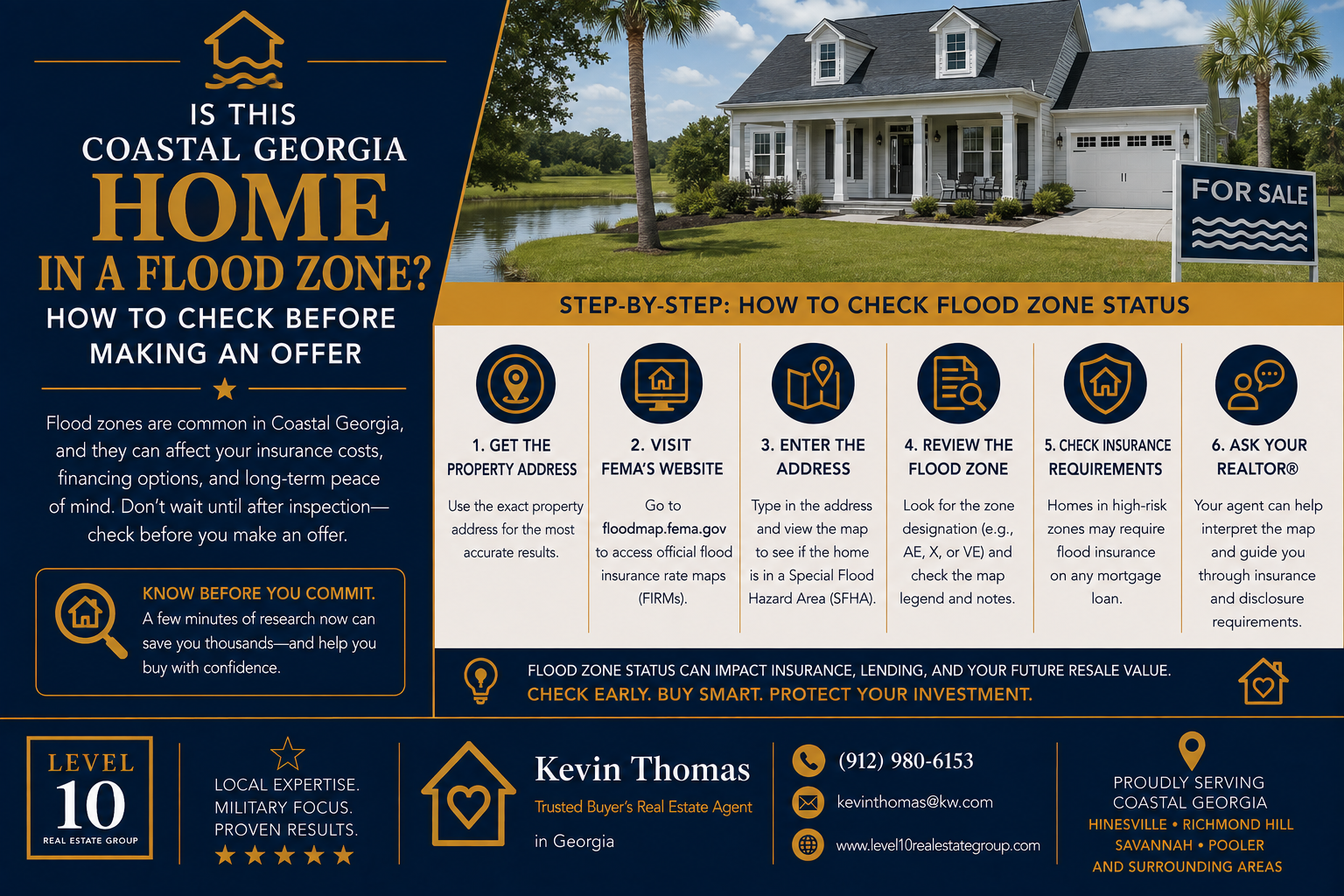
Is This Coastal Georgia Home in a Flood Zone? How to Check Before Making an Offer

Written by Kevin Thomas
Flood zone status is one of the few things about a home that can genuinely change the math on whether you can afford it — and it's also one of the easiest things to check before you ever write an offer. Too many buyers find out during underwriting, after they've already fallen in love with the house. That's the wrong order.
👉 If a home sits in a FEMA Special Flood Hazard Area and you're financing with a VA Loan, flood insurance isn't optional — it's a federal requirement, and it needs to be priced into your decision before you make an offer, not discovered during underwriting.
Here's exactly how to check, and what the zone designation actually means once you know it.
What FEMA Flood Zones Actually Mean
Zone X sits outside FEMA's Special Flood Hazard Area entirely — there's no federal flood insurance requirement even with a federally backed loan like a VA Loan. This is the designation most buyers hope to see.
Zone A and Zone AE fall within the Special Flood Hazard Area (SFHA) — land with at least a 1% annual chance of flooding, commonly called the 100-year floodplain. Zone AE specifically includes a determined Base Flood Elevation (BFE), the specific elevation flood waters are expected to reach in that base flood event.
Zone VE is the coastal equivalent of Zone AE — a coastal high-hazard area where wave action is a factored risk in addition to base flooding. This is generally the most expensive zone to insure and the most restrictive to build or renovate in.
Why Federally Backed Loans Make This Non-Negotiable
This is the detail that catches buyers off guard: if a home is in any A-designated zone and you're financing with a VA Loan — or any federally backed mortgage — flood insurance is legally required, not a recommendation. Your lender will require proof of an active flood insurance policy before closing, and it isn't something you can decline or defer.
This makes flood zone status a real affordability question, not just a risk consideration. A home's true monthly cost includes whatever flood premium comes with its zone designation — and that number can vary enormously between two otherwise comparable homes just a few blocks apart.
How to Actually Check Before You Make an Offer
Use FEMA's Flood Map Service Center (msc.fema.gov) — it's free, official, and takes an address lookup to return the specific flood zone designation for any property in the country. This should be one of the first things you check on a home you're seriously considering, right alongside school zone and commute time.
Ask the listing agent directly for the flood zone designation and any existing elevation certificate. Many sellers already have this information on file, particularly in a market where flood zone status regularly comes up in transactions.
Don't rely on assumptions based on how far a home looks from water. Flood zone boundaries follow elevation and drainage modeling, not visual distance from the coast or a marsh — a home that doesn't look "coastal" can still fall inside a mapped SFHA.
Where Flood Risk Varies Most in This Market
Flood zone prevalence in this region tracks closely with proximity to the coast, tidal marshes, and river systems. Areas closer to Savannah, the coastal marshlands, and waterways carry meaningfully higher SFHA exposure than inland communities like Hinesville and the areas immediately around Fort Stewart, which sit further from tidal influence. This pattern lines up with the same regional insurance cost difference that shows up in overall homeownership budgeting — inland Liberty County properties typically carry lower combined insurance costs than homes closer to Chatham County's coastline.
That doesn't mean every coastal-adjacent home is a bad decision — it means the flood zone check has to happen early enough to factor accurately into your budget before you're emotionally invested in a specific property.
The LOMA Option: When a Flood Zone Designation Can Be Wrong
Flood maps aren't always precise at the individual property level, and a home can sometimes be mapped into a flood zone incorrectly — genuinely sitting on higher ground than the surrounding area's general elevation data suggests. In these cases, a property owner can apply for a Letter of Map Amendment (LOMA) from FEMA.
A LOMA officially removes a specific property from the mapped floodplain for insurance purposes, typically based on a licensed surveyor's Elevation Certificate proving the home's lowest grade sits above the Base Flood Elevation. FEMA doesn't charge a fee to review a LOMA application, and if approved, the flood insurance requirement can be removed with your lender based on FEMA's determination letter.
If you're seriously considering a home that's borderline-mapped into a flood zone, ask whether an elevation certificate already exists, or whether a LOMA application might realistically apply — this is worth raising with your agent before you assume the flood insurance cost is fixed and unavoidable.
What to Do If a Home You Love Is in a Flood Zone
Get a real flood insurance quote before you write your offer, not after — this number needs to be part of your actual monthly budget comparison between homes, not an afterthought discovered during underwriting.
Ask about elevation certificates and LOMA feasibility if the mapping seems questionable relative to the home's actual site conditions.
Factor the true cost into your offer strategy — a home in a flood zone isn't automatically a bad choice, but it should be priced and negotiated with full knowledge of what it will actually cost to insure and own.
Why Work With Kevin Thomas
Checking flood zone status before you fall in love with a home — and knowing what your real options are if a property is mapped into one — protects your budget and your peace of mind. Kevin Thomas is a trusted buyer's agent and marketing strategist serving Coastal Georgia, with deep experience helping military families and relocating buyers factor flood risk accurately into every offer throughout Hinesville, Richmond Hill, Savannah, and the surrounding region.
Working with Kevin means:
✔️ Flood zone verification on every property before you write an offer ✔️ Real insurance cost estimates factored into your true monthly budget ✔️ Guidance on elevation certificates and LOMA feasibility for borderline properties ✔️ Straight talk about where flood risk runs highest and lowest across this market ✔️ An advocate who catches this before it becomes a closing-week surprise
Your Next Step
Call or text Kevin Thomas: (912) 980-6153 Before you write an offer on a Coastal Georgia home, know exactly what flood zone it's in — and what that actually costs.
Kevin Thomas with Level 10 Real Estate Group helps Coastal Georgia buyers factor flood risk into every decision, before it becomes an expensive surprise.

Karyn Thomas
Lead Listing Agent/ Co-Team Owner | Level 10 Real Estate Group | Keller Williams Coastal Area Partners
or another way