
Categories
Seller Guides, Military Relocation, VA Loan Guide, VA Loan Tips, Fort Stewart Area Homes, Fort Stewart PCS, Fort Stewart Real Estate, Coastal Georgia Homes, Coastal Georgia Real EstatePublished September 18, 2026
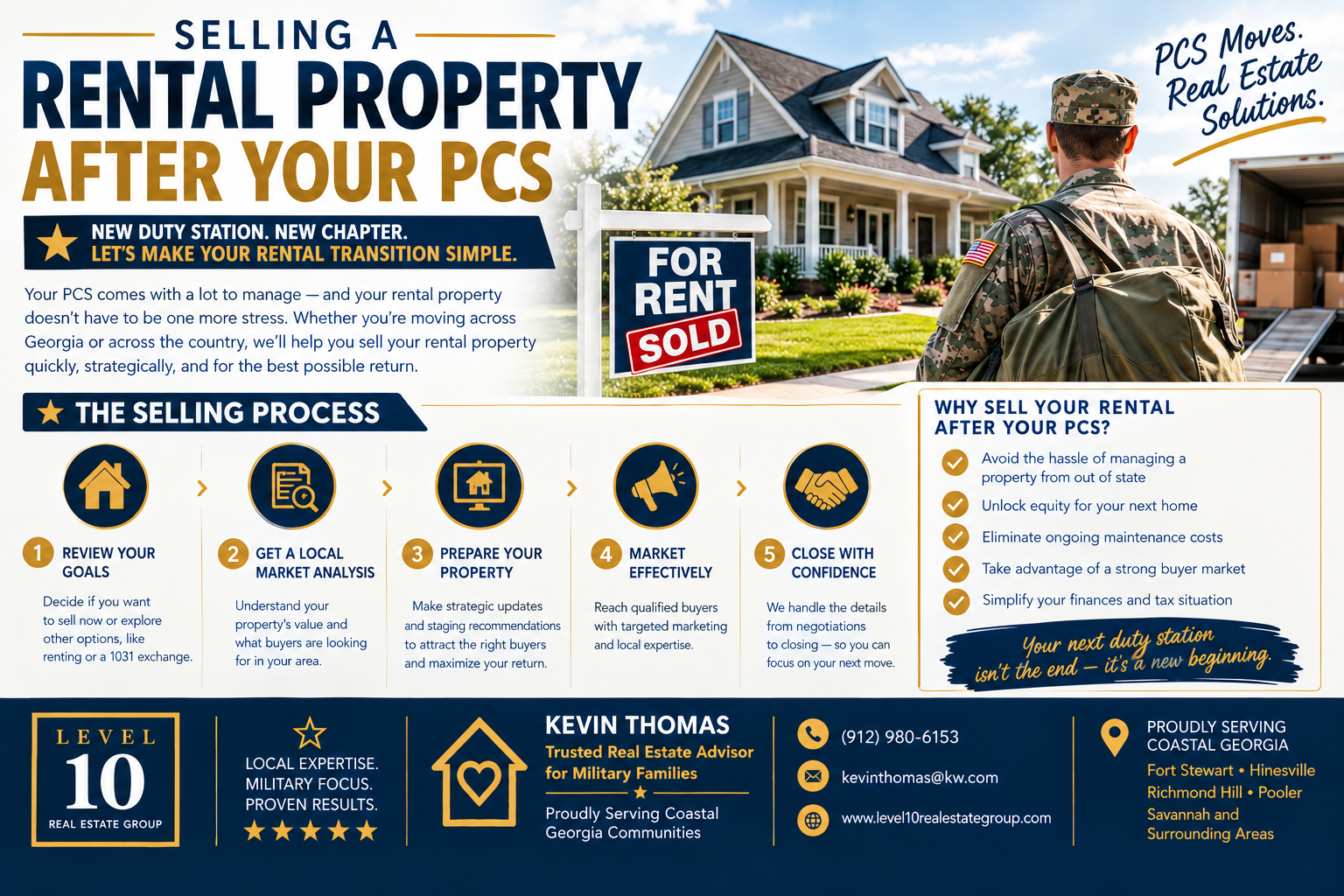
Selling a Rental Property After Your PCS

Written by Kevin Thomas
If you converted a Fort Stewart area home into a rental during a previous PCS and you're now deciding whether to sell it, this is a genuinely different transaction than selling a home you've lived in. A tenant may still be living there, the tax picture includes a piece most owner-occupant sellers never encounter, and your buyer pool looks different too.
👉 Depreciation you claimed every year you rented this property out gets "recaptured" and taxed at up to 25% when you sell — separately from, and in addition to, any capital gains tax on the sale itself.
Here's what actually changes when the home you're selling has been a rental, not a residence.
Depreciation Recapture: The Tax Most Landlords Forget About
Every year you rented this property, you (or your tax preparer) likely claimed depreciation on the building — a deduction that reduced your taxable rental income year after year. When you sell, the IRS recaptures that benefit, taxing the total depreciation you claimed at a flat rate of up to 25%, regardless of your regular income tax bracket. This is separate from, and in addition to, standard long-term capital gains tax — which applies at 0%, 15%, or 20% depending on your income, on any further gain above the depreciation amount.
This is worth calculating with a tax professional before you list, not after you've already sold. A property that looks like a clean, straightforward sale on paper can carry a meaningfully larger tax bill than an owner-occupied sale of the same home would, purely because of years of depreciation deductions coming due.
Does the Capital Gains Exclusion Still Apply?
If this home was originally your primary residence before you converted it to a rental, the military-specific capital gains provision under IRC §121(d)(9) may still let you exclude up to $250,000 ($500,000 married filing jointly) of gain, even after years as a rental — PCS orders can suspend the standard 5-year look-back period for up to 10 additional years. This exclusion applies to the capital gains portion, not the depreciation recapture — recapture tax is owed regardless of whether the §121 exclusion applies to the rest of your gain. Confirming exactly how these two rules interact with your specific timeline is a conversation worth having with a tax professional before you decide when to list.
Selling With a Tenant Still in the Home
Georgia has no statute setting a specific landlord-entry notice period for showings — this is governed by your lease and the tenant's common-law right to quiet enjoyment under O.C.G.A. § 44-7-1. Critically, Georgia landlords have no automatic legal right to show an occupied rental for sale — that access has to be addressed in the lease agreement itself. If your current lease is silent on showings, you'll need the tenant's cooperation, not just your own authority as owner, to schedule them.
Where a lease is silent, the practice Georgia courts and legal-aid guidance treat as reasonable is at least 24 hours' advance written notice, for a legitimate purpose, during reasonable hours. Start this conversation with your tenant early and in writing — a cooperative tenant who understands the timeline and process makes showings dramatically smoother than one who feels blindsided by them.
Vacant vs. Tenant-Occupied: Two Different Buyer Pools
A vacant home draws from your full buyer pool — owner-occupants imagining themselves living there, plus investors. A tenant-occupied home selling with the lease in place primarily attracts investor buyers, since an owner-occupant typically can't move in until the lease ends. This usually means a smaller, more specialized buyer pool and can affect both your sale timeline and your negotiating position, particularly if the remaining lease term is long.
If your tenant's lease is ending soon relative to your sale timeline, waiting until the unit is vacant can open up the owner-occupant buyer pool and potentially a stronger sale price — worth weighing against the extra weeks or months that adds to your process.
Consider Whether a 1031 Exchange Fits Your Plans
If you're planning to reinvest the proceeds into another rental property rather than cash out, a 1031 exchange allows you to defer both capital gains and depreciation recapture tax by rolling the proceeds into a replacement investment property, under strict IRS timing rules. This only applies to investment property, not a primary residence, and it requires working with a qualified intermediary and meeting specific deadlines — this is a strategy to discuss with a tax professional well before you list if it's even a possibility for your situation.
What to Actually Do Before You List
Get a depreciation recapture estimate from a tax professional early — this number belongs in your net proceeds math from the start, not as a surprise at tax time next year.
Review your lease for showing-access language now, and if it's silent, start a written conversation with your tenant well before you need access.
Decide whether waiting for vacancy makes financial sense given your specific lease timeline and PCS schedule.
Ask about a 1031 exchange if you're planning to reinvest, since the deadlines involved require planning before your sale closes, not after.
Why Work With Kevin Thomas
Selling a rental property involves tax and access considerations that simply don't apply to an owner-occupied sale, and getting ahead of them protects both your timeline and your bottom line. Kevin Thomas is a trusted buyer's agent and marketing strategist serving Coastal Georgia, with deep experience helping military landlords navigate the sale of tenant-occupied and former-rental properties.
Working with Kevin means:
✔️ Early awareness of depreciation recapture, so it's in your numbers from day one ✔️ Guidance on lease review and tenant communication for showing access ✔️ An honest read on vacant versus tenant-occupied sale strategy for your timeline ✔️ Awareness of 1031 exchange timing if reinvesting is part of your plan ✔️ Support marketing effectively to the right buyer pool for your specific situation
Your Next Step
Call or text Kevin Thomas: (912) 980-6153 If you're selling a Fort Stewart area rental after your PCS, get ahead of the tax and tenant details before you list.
Kevin Thomas with Level 10 Real Estate Group helps military landlords sell rental property with a clear, accurate picture of what's actually involved.

Karyn Thomas
Lead Listing Agent/ Co-Team Owner | Level 10 Real Estate Group | Keller Williams Coastal Area Partners
or another way