
Categories
Seller Guides, Home Selling Tips, VA Loan Guide, VA Loan Tips, Coastal Georgia Homes, Coastal Georgia Real EstatePublished August 28, 2026
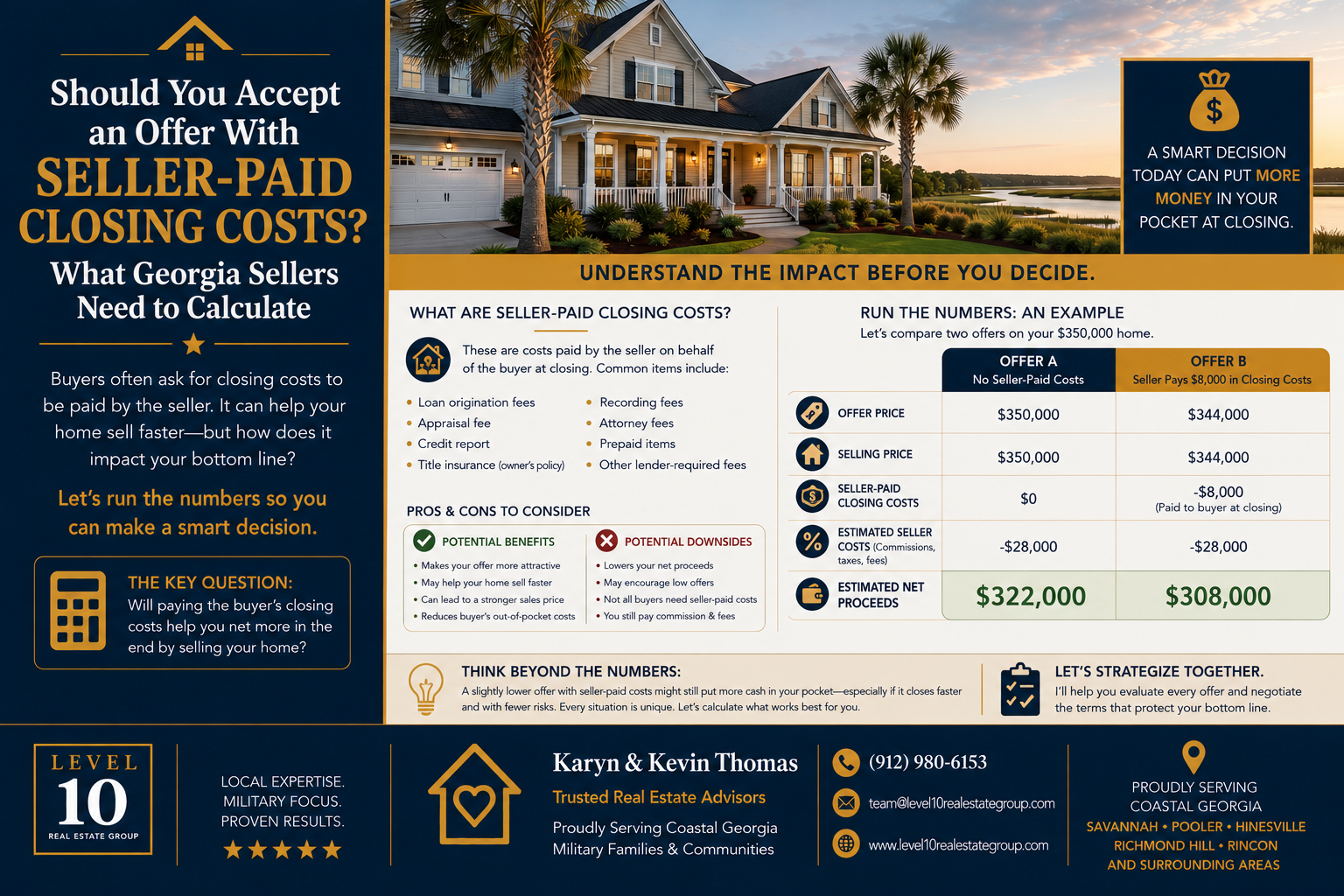
Should You Accept an Offer With Seller-Paid Closing Costs? What Georgia Sellers Need to Calculate

Written by Kevin Thomas
Sellers comparing two offers almost always gravitate toward the higher number on the contract. That instinct can actually cost you money the moment one of those offers includes a seller-paid closing cost credit — because the math behind it isn't as simple as "higher price wins."
👉 A $325,000 offer with a $5,000 seller-paid closing cost credit can net you less than a straight $320,000 offer with no credit at all — because commission is calculated on the higher gross contract price, not on what you actually walk away with.
Here's the real math, and what to actually check before you accept either offer.
Why Buyers Ask for Seller-Paid Closing Costs
This request comes up constantly with VA buyers financing with $0 down — they aren't bringing a down payment to the table, and closing costs are frequently the one out-of-pocket expense standing between them and closing. Asking the seller to cover some or all of those costs, often by structuring a slightly higher offer price with a corresponding credit, is a completely standard and reasonable negotiation — but it changes the math on your side in a way that's easy to miss if you're only looking at the top-line number.
The Math Most Sellers Get Wrong: Comparing Offers by Net Proceeds, Not Face Price
Here's a direct comparison, using a 5% total commission for both offers:
Offer A: $320,000, no seller credit. Commission (5% of $320,000): $16,000 Net before other closing costs: $304,000
Offer B: $325,000, with a $5,000 seller-paid closing cost credit to the buyer. Commission (5% of $325,000): $16,250 Seller credit to buyer: $5,000 Net before other closing costs: $303,750
Offer B nets $250 less than Offer A, despite having a $5,000 higher face price — because commission is calculated on the full $325,000 contract price, not on the $320,000 you'd actually be netting from the buyer after the credit. The higher number on the contract can be genuinely misleading if you're not running this calculation before you accept.
This doesn't mean seller-paid closing cost offers are bad — it means every offer needs to be evaluated at the net proceeds line, not the contract price line, exactly the way we've broken down net proceeds calculations in general. A credit-structured offer might still be your best option for other reasons — a stronger buyer, a cleaner timeline, fewer contingencies — but it should never be assumed superior purely because the top-line number looks bigger.
VA's 4% Seller Concession Cap: What Actually Counts
This is a detail that confuses a lot of sellers and even some agents, so it's worth being precise about. VA loans cap total seller concessions at 4% of the home's VA-appraised reasonable value — but "concessions" has a specific, narrower definition than most people assume.
What counts toward the 4% cap: the VA funding fee, prepaid taxes and escrows, payoff of the buyer's other debts, gift funds, and any discount points beyond what the market would normally require for the buyer's rate.
What does NOT count toward the cap: normal closing costs the seller agrees to pay — title insurance, recording fees, attorney fees, and real estate commissions — because these are considered the seller's customary transaction obligations, not concessions in the VA's technical sense. Market-appropriate discount points also fall outside the cap; only points paid beyond what current rates would typically require count against it.
The practical result: a seller can cover a VA buyer's standard closing costs in full and still separately offer up to 4% in additional concessions on top of that — these are two different buckets, not one combined limit. Understanding this distinction can open up more flexible negotiation than either side initially assumes.
The Appraisal Risk of Inflating Price to Cover a Credit
If a buyer's offer raises the contract price specifically to fund a credit, the home still has to appraise at that higher contract price for a VA loan to close at the agreed terms. If your local comps don't support the inflated price, you're looking at a potential appraisal gap — and recall that the VA's mandatory amendatory clause lets the buyer walk away with their earnest money fully protected if the appraisal comes in low. A credit-inflated price that doesn't hold up at appraisal can cost you a deal entirely, not just some commission math.
Before accepting a price-plus-credit structure, ask your agent to run comps specifically at that higher number — not just at the number you'd have accepted without the credit attached.
How to Actually Evaluate Any Offer
Calculate every offer down to estimated net proceeds, not contract price — commission, any credits, prorated taxes, and standard Georgia closing costs all factored in before you compare numbers side by side.
Confirm whether a requested credit falls under the VA's concession cap or the uncapped standard closing cost category — this affects how much flexibility actually exists in the negotiation.
Check that a credit-inflated price still supports realistic comps before you accept it, protecting yourself from an appraisal-driven deal collapse down the line.
Why Work With Kevin Thomas
Comparing offers accurately — at the net proceeds line, not the contract price — is exactly the kind of math that determines whether you're accepting the genuinely stronger offer or just the one that looks bigger on paper. Kevin Thomas is a trusted buyer's agent and marketing strategist serving Coastal Georgia, with deep experience helping sellers evaluate offers with seller-paid closing costs, VA concessions, and everything in between.
Working with Kevin means:
✔️ Every offer run to actual net proceeds before you decide, not just compared by contract price ✔️ Clear guidance on what counts toward the VA's 4% concession cap and what doesn't ✔️ Comp analysis before accepting a credit-inflated price, protecting you from appraisal risk ✔️ Straight talk about which offer structure genuinely serves you best ✔️ An advocate who does the real math, not just the obvious comparison
Your Next Step
Call or text Kevin Thomas: (912) 980-6153 Before you accept an offer with seller-paid closing costs, make sure you know your real net — not just the number on the contract.
Kevin Thomas with Level 10 Real Estate Group helps Coastal Georgia sellers compare offers the right way, every time.

Karyn Thomas
Lead Listing Agent/ Co-Team Owner | Level 10 Real Estate Group | Keller Williams Coastal Area Partners
or another way