Categories
VA Loan Guide, Military Buyers, Coastal Georgia Homes, Fort Stewart Real Estate, Hunter Army Airfield, Military Relocation, Home Buying TipsPublished July 21, 2026
VA Loan Closing Costs: What Military Buyers in Coastal Georgia Pay

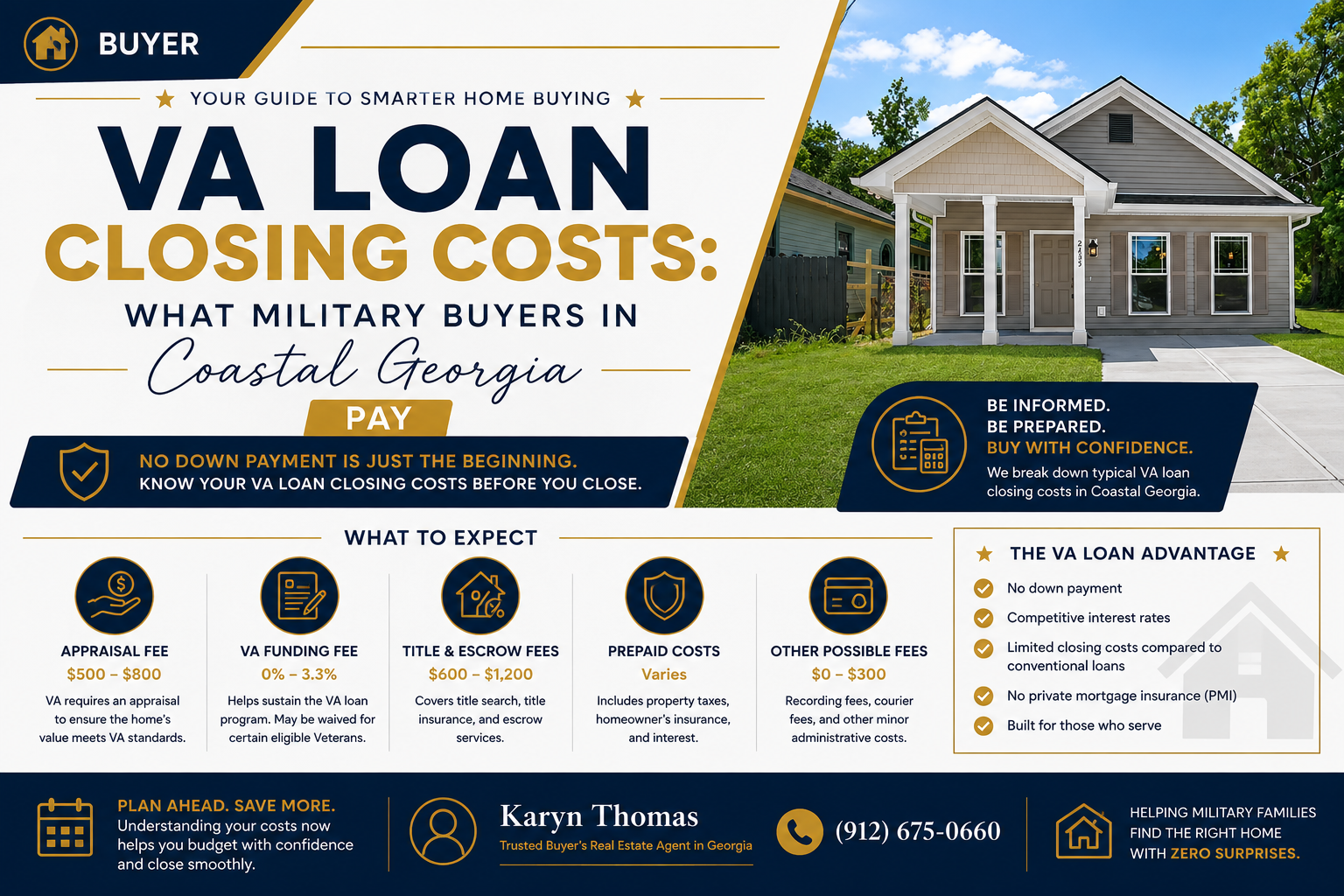
"The VA Loan requires no down payment" — military buyers know this. What catches many first-time VA buyers off guard is what comes next:
👉 Closing costs. They exist even on VA Loans — and if you're not prepared for them, they can be a surprise on an otherwise smooth PCS move to Fort Stewart or Hunter Army Airfield.
The good news is that VA Loans have some of the most favorable closing cost structures of any loan product on the market. The VA limits certain fees, eliminates others, and gives you tools to reduce your out-of-pocket costs at closing significantly — sometimes to near zero.
But understanding how it all works requires knowing exactly what you're paying, what you're protected from, and what strategies are available to minimize cash out of pocket in Coastal Georgia's market.
This is your complete breakdown.
What Are Closing Costs?
Closing costs are the fees and prepaid expenses required to complete a real estate transaction — paid at closing, on top of (or in place of) a down payment.
They fall into two main categories:
Lender fees — Charges from your mortgage lender for processing and originating your loan.
Third-party fees — Charges from outside parties involved in the transaction: title company, attorney, appraiser, government recording offices, and insurance providers.
On a conventional loan, closing costs typically run 2%–5% of the purchase price. The VA Loan's rules reduce this significantly for eligible military buyers — but costs still exist and need to be planned for.
The VA's Closing Cost Framework: Allowable vs. Non-Allowable Fees
The VA divides closing costs into two categories — fees the VA will allow buyers to pay, and fees the VA prohibits buyers from paying.
VA Allowable Fees — What You CAN Pay
These are the fees VA regulations permit military buyers to pay at closing:
VA Funding Fee — The one-time fee charged by the VA to sustain the loan program. More on this below — it's the largest VA-specific cost.
Loan Origination Fee — Capped at 1% of the loan amount for VA Loans. On a $300,000 loan, maximum origination = $3,000.
VA Appraisal Fee — Typically $500–$700 in the Coastal Georgia area. This is ordered through the VA's appraisal management system and paid by the buyer (or rolled into the loan in some cases).
Credit Report Fee — Usually $30–$50. Your lender pulls your credit as part of the pre-approval process.
Title Search and Title Insurance — Required to verify clean title on the property. In Georgia, lender's title insurance is required and typically runs $500–$1,200 depending on loan amount.
Recording Fees — Government fees to record the deed and mortgage with Liberty County, Chatham County, Bryan County, or whichever county your home is in. Typically $50–$200 in Georgia.
Survey Fee — If required, typically $300–$600 in Coastal Georgia. Not always required — your agent can advise.
Attorney Fee — Georgia is an attorney state — meaning a licensed Georgia real estate attorney must conduct the closing. Attorney fees in the Coastal Georgia area typically run $400–$800.
Discount Points — If you choose to buy down your interest rate, you can pay discount points (each point = 1% of the loan amount). This is optional and borrower-driven.
Prepaid Items — See the full breakdown in the prepaid section below.
VA Non-Allowable Fees — What You CANNOT Be Charged
The VA prohibits lenders from charging VA buyers certain fees that are common on conventional loans:
- Lender attorney fees (beyond standard closing attorney)
- Loan application fees
- Prepayment penalty fees
- Mortgage broker commission (above the 1% origination cap)
- Settlement charges that exceed VA limits
- Document preparation fees charged separately from the origination fee
- Escrow or settlement fees above the VA allowable amount
👉 These protections reduce your closing cost exposure compared to conventional buyers — and they apply regardless of which VA-approved lender you use.
The VA Funding Fee: Your Biggest Variable Cost
The VA Funding Fee is a one-time charge that goes directly to the VA to sustain the loan program for future servicemembers. It is the largest VA-specific closing cost — and it varies based on several factors.
Funding Fee Rates in 2026
| Loan Use | No Down Payment | 5% Down | 10% Down |
|---|---|---|---|
| First VA Loan | 2.15% | 1.50% | 1.25% |
| Subsequent VA Loan | 3.30% | 1.50% | 1.25% |
On a $300,000 purchase — first-time VA Loan user, no down payment: $300,000 × 2.15% = $6,450 VA Funding Fee
On a $350,000 purchase — subsequent VA Loan use, no down payment: $350,000 × 3.30% = $11,550 VA Funding Fee
The Funding Fee Can Be Financed
The VA Funding Fee does not have to be paid at closing out of pocket. It can be rolled directly into the loan amount — meaning your loan balance increases by the funding fee amount, but your cash to close is unaffected.
Example: $300,000 purchase + $6,450 funded fee = $306,450 total loan amount
Funding Fee Exemptions
The following buyers are completely exempt from the VA Funding Fee:
- Veterans receiving VA compensation for a service-connected disability
- Veterans who would be entitled to VA compensation but are receiving retirement or active duty pay
- Surviving spouses of veterans who died in service or from service-connected disability
- Active duty servicemembers who have received the Purple Heart
- Active duty servicemembers who have been awarded the Medal of Honor
👉 If you have any service-connected disability rating — even 0% rated — check your specific exemption status with the VA before closing. The funding fee exemption can save thousands of dollars and does not apply retroactively once the loan has closed.
Prepaid Items: The "Costs" That Are Actually Your Money
Prepaid items are often lumped into "closing costs" but they're fundamentally different — they're not fees paid to service providers. They're your own money being collected upfront to fund your escrow account and pay the first period of certain recurring expenses.
Prepaid items on a VA Loan in Coastal Georgia typically include:
Prepaid Homeowner's Insurance
Your lender requires proof of active homeowner's insurance before closing. You'll typically pay the first full year's premium upfront — usually $1,000–$2,500 annually in Coastal Georgia, depending on the home's value, location, and construction type.
Coastal Georgia note: Proximity to the coast affects insurance premiums. Homes in Liberty County, Chatham County, and Bryan County may carry higher windstorm exposure than inland markets. Get an insurance quote early in your home search — before you're under contract — so there are no premium surprises at closing.
Prepaid Property Taxes
Your lender collects a property tax escrow cushion at closing — typically 2 to 3 months of estimated monthly taxes — to ensure the account has a buffer when the first tax bill arrives.
Property tax rates in Coastal Georgia vary by county:
- Liberty County (Hinesville area): Millage rate varies by specific district; confirm with your lender
- Chatham County (Savannah/Pooler area): Confirm current rate with lender
- Bryan County (Richmond Hill area): Confirm current rate with lender
- Effingham County (Guyton/Pooler area): Confirm current rate with lender
On a $300,000 home, annual property taxes in the Coastal Georgia area commonly range from $2,000–$4,500 depending on county and applicable exemptions. Remember: Georgia's homestead exemption reduces assessed value for primary residences — file for it after closing.
Prepaid Mortgage Interest
You'll pay interest from your closing date through the end of the month at closing. If you close on July 15, you'll pay 16 days of interest (July 15–31) as a prepaid. This amount varies based on your loan amount and interest rate.
Pro tip: Closing earlier in the month means more days of prepaid interest. Closing at the end of the month minimizes this cost. It's a small amount — typically $200–$800 — but worth knowing.
HOA Dues (If Applicable)
If your home is in an HOA community, your lender may collect a prorated portion of dues and/or an initial escrow cushion at closing. HOA transfer fees paid to the HOA itself (seller responsibility in most cases) are separate.
Flood Insurance Escrow (If Applicable)
If your Coastal Georgia home is in a FEMA-designated flood zone requiring flood insurance, your lender will escrow flood insurance premiums alongside homeowner's insurance. Flood insurance premiums in Zone AE areas of Coastal Georgia can range from $500–$2,500+ annually depending on the property's elevation and coverage amounts.
Estimated Cash to Close: Real Numbers for Coastal Georgia
Here are realistic cash-to-close estimates for VA buyers in the Coastal Georgia market in 2026, assuming the funding fee is financed into the loan:
$250,000 Purchase — Hinesville Area, First-Time VA User
| Item | Estimated Cost |
|---|---|
| Down Payment | $0 |
| VA Funding Fee (financed) | $0 at closing |
| Origination Fee (1%) | $2,500 |
| VA Appraisal Fee | $600 |
| Title/Attorney Fees | $1,000 |
| Credit Report | $50 |
| Recording Fees | $150 |
| Prepaid Insurance (1 year) | $1,200 |
| Prepaid Tax Escrow (2 months) | $500 |
| Prepaid Interest (mid-month close) | $400 |
| Estimated Cash to Close | ~$6,400 |
$350,000 Purchase — Richmond Hill/Pooler Area, First-Time VA User
| Item | Estimated Cost |
|---|---|
| Down Payment | $0 |
| VA Funding Fee (financed) | $0 at closing |
| Origination Fee (1%) | $3,500 |
| VA Appraisal Fee | $650 |
| Title/Attorney Fees | $1,200 |
| Credit Report | $50 |
| Recording Fees | $150 |
| Prepaid Insurance (1 year) | $1,600 |
| Prepaid Tax Escrow (2 months) | $700 |
| Prepaid Interest (mid-month close) | $550 |
| Estimated Cash to Close | ~$8,400 |
Note: These are estimates. Your actual Loan Estimate and Closing Disclosure will reflect precise figures from your specific lender, county, and property.
How to Reduce Your VA Loan Closing Costs in Coastal Georgia
Strategy #1 — Seller Concessions (Up to 4% of Purchase Price)
This is the most powerful tool available to VA buyers for reducing out-of-pocket closing costs.
VA guidelines allow sellers to contribute up to 4% of the purchase price toward buyer closing costs and prepaid items. This is called a seller concession — and it can cover essentially all of your closing costs in many Coastal Georgia transactions.
On a $300,000 home: 4% = $12,000 in potential seller concessions
That $12,000 can cover origination fees, title/attorney fees, appraisal, prepaid insurance, prepaid taxes, and even the VA Funding Fee — potentially bringing your cash to close to near zero.
How to use seller concessions: Your agent includes the concession request in your purchase offer. In a normal market, a well-structured offer asking for 2–3% in concessions alongside a competitive price is often accepted — particularly from motivated sellers who want a clean VA transaction.
👉 In today's Coastal Georgia market, where sellers near Fort Stewart and HAAF are accustomed to VA buyers, seller concession requests are common and frequently approved.
Strategy #2 — Lender Credits
Some lenders offer lender credits — they absorb a portion of your closing costs in exchange for a slightly higher interest rate. This is a legitimate trade-off that makes sense for buyers who are cash-constrained but want to keep their long-term payment lower than a seller concession alone achieves.
Discuss this option with your VA lender early in the process.
Strategy #3 — Finance the VA Funding Fee
As discussed above, rolling the funding fee into the loan amount eliminates it from your cash-to-close calculation. Most VA buyers take this option — it adds a small amount to your monthly payment but removes the largest single VA-specific closing cost from what you need at the table.
Strategy #4 — Negotiate Lender Fees
The VA caps origination at 1%, but some lenders charge less. Shopping two to three VA-experienced lenders in the Coastal Georgia area and comparing their Loan Estimates can reveal meaningful fee differences. A lender who charges 0.75% origination instead of 1% saves $750 on a $300,000 loan.
Strategy #5 — Close at End of Month
Closing on the 28th, 29th, or 30th of the month reduces your prepaid interest to just 1–3 days. On a $300,000 loan, this can save $300–$500 compared to a mid-month closing.
How to Read Your Loan Estimate and Closing Disclosure
Two critical documents govern your closing costs on a VA Loan:
Loan Estimate (LE)
Your lender is required to provide a Loan Estimate within 3 business days of receiving your completed loan application. This document breaks down:
- Estimated loan terms (rate, monthly payment)
- Estimated closing costs by category
- Estimated cash to close
- Estimated monthly payment including escrow
Review this document carefully and ask your lender to explain any line item you don't understand.
Closing Disclosure (CD)
You'll receive your Closing Disclosure at least 3 business days before closing. This document shows the final, confirmed closing costs — and it should closely match your Loan Estimate.
Compare the CD to the LE line by line. Significant increases in specific fee categories are regulated by the VA and consumer protection rules — ask your lender to explain any material changes before you sign.
👉 Never arrive at closing seeing the Closing Disclosure for the first time. Review it with your agent and lender the moment it arrives.
VA Closing Costs vs. Conventional: The Real Comparison
| Cost Item | VA Loan | Conventional (5% Down) |
|---|---|---|
| Down Payment | $0 | $15,000 (on $300K) |
| PMI | None | ~$150–$250/month |
| Funding Fee | 2.15% (can finance) | None |
| Origination Fee Cap | 1% | No cap |
| Non-allowable fees | Prohibited | Charged |
| Seller Concessions | Up to 4% | Up to 3–6% |
| Estimated Cash to Close | $5,000–$10,000 | $20,000–$30,000 |
👉 Even accounting for the VA Funding Fee, the total cash required to close a VA Loan in Coastal Georgia is dramatically lower than a conventional loan for most military buyers — particularly when seller concessions are negotiated effectively.
Why Work With Kevin Thomas
Understanding VA Loan closing costs in theory is one thing. Navigating them strategically in the Coastal Georgia market — negotiating seller concessions, comparing lender fees, and reading a Closing Disclosure with confidence — is another.
Kevin Thomas is a trusted military buyer's agent in Coastal Georgia, helping military families near Fort Stewart and Hunter Army Airfield structure VA offers that minimize out-of-pocket costs and maximize the financial benefit of their earned benefit.
Working with Kevin means:
✔️ Expert guidance on negotiating seller concessions specific to Coastal Georgia market conditions ✔️ Referrals to VA-experienced lenders who provide clear, competitive fee structures ✔️ Step-by-step review of your Loan Estimate and Closing Disclosure before closing day ✔️ A buying strategy that gets you to the closing table with as little cash out of pocket as possible ✔️ A committed advocate from pre-approval through the day you get your keys
Your Next Step
Call or text Kevin Thomas: (912) 980-6153 Let's build a buying strategy that puts your VA Loan benefit to work — and keeps more money in your pocket at closing.
Kevin Thomas with Level 10 Real Estate Group helps military buyers in Coastal Georgia understand every dollar of their closing costs, negotiate strategically, and close with confidence — without financial surprises.

Karyn Thomas
Lead Listing Agent/ Co-Team Owner | Level 10 Real Estate Group | Keller Williams Coastal Area Partners
or another way