Categories
Home Buying Tips, VA Loan Guide, VA Loan Tips, Coastal Georgia Homes, Coastal Georgia Real Estate, Buyer Guides, Rural PropertiesPublished August 12, 2026
Well Water vs. City Water: What Coastal Georgia Homebuyers Should Know

Written by Kevin Thomas
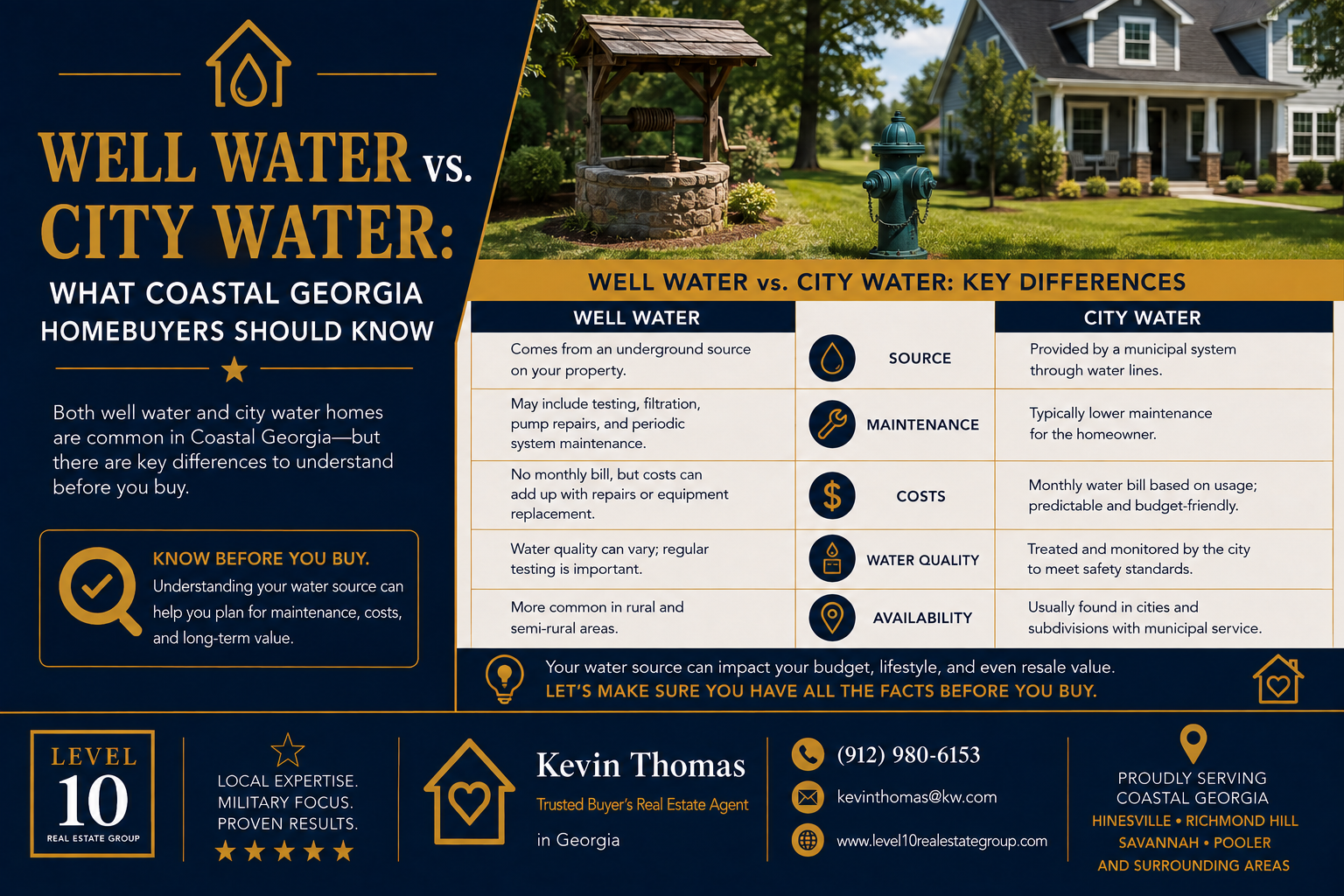
Buyers relocating from more urban markets often don't think twice about where their water comes from — until they tour a home in Long County or rural Bryan County and find out it's on a private well. That's not a reason to walk away, but it does come with its own testing requirements, water quality considerations, and long-term costs that a city-water home simply doesn't have.
👉 A private well doesn't come with a monthly water bill, but it does come with maintenance costs, water quality issues specific to this region's geology, and a mandatory VA water test with results that only stay valid for 90 days.
Here's what to actually know before you buy either one.
Where You'll Find Each in Coastal Georgia
City or county water systems are standard in the more developed corridors — central Hinesville, Richmond Hill's newer subdivisions, and Savannah's metro area.
Private wells are common once you move toward the rural edges of Liberty County, throughout much of Long County around Ludowici, and in older or more rural sections of Bryan County. Neither is inherently better — but they come with very different due diligence checklists.
What VA Financing Requires for a Well
VA Loans can finance a home on a private well, but the water has to pass specific testing before the loan can close:
Coliform bacteria — total coliform and E. coli must be absent from the sample entirely. Any presence of either fails the test.
Nitrates and nitrites must stay below 10 mg/L, the EPA's maximum contaminant level.
Lead must stay below 15 ppb, the EPA's action level.
The sample must be collected by a disinterested third party — not the buyer, seller, or their agents — and results are only valid for 90 days, which matters if your closing timeline runs long or gets delayed.
If the property also has a septic system, remember the VA's separate requirement of at least 100 feet of separation between the well and the septic tank and drain field — a detail worth confirming alongside the water test itself.
Common Well Water Quality Issues in This Region
Coastal Georgia's geology produces a fairly predictable set of well water issues, beyond just the three VA-tested contaminants:
Iron and manganese are the most common nuisance issue in Georgia groundwater — showing up as staining on fixtures, a metallic taste, and orange or brown discoloration, especially after the well has sat unused for a period.
Sulfur bacteria produce the unmistakable "rotten egg" smell of hydrogen sulfide gas — unpleasant, but typically treatable with the right filtration system rather than a sign of unsafe water.
Arsenic occurs naturally in bedrock and aquifer sediments across Georgia's Southern Coastal Plain region, which includes this area. It's not part of the VA's required test panel, which is exactly why it's worth testing for independently, especially on a property that's never had comprehensive water testing done.
Saltwater intrusion is a documented, ongoing concern for Georgia's coastal aquifer system, most acutely in the immediate coastal counties like Chatham, Glynn, and Camden, where the state has capped groundwater withdrawals to help manage it. It's a useful piece of regional context even for buyers slightly further inland, since it reflects broader pressure on the same aquifer system this region draws from.
The Real Cost Comparison: Well vs. City Water
No monthly water bill is the most obvious advantage of a private well — but it isn't free to maintain. Submersible well pumps typically last 8–15 years and cost $1,500–$4,000+ to replace when they fail. Pressure tanks, treatment systems for iron or sulfur issues, and periodic testing all add real, if irregular, costs that a city-water homeowner doesn't carry.
City or county water comes with a predictable monthly bill, but no pump to maintain, no pressure tank to monitor, and quality overseen by a utility rather than the homeowner alone. For buyers who prefer predictable costs over the occasional larger maintenance expense, that trade-off is worth weighing honestly rather than assuming a well is simply "free water."
Testing Doesn't Stop at Closing
The VA-required water test is a one-time snapshot taken to close your loan — it is not an ongoing quality guarantee. Well water quality can change over time due to seasonal water table shifts, nearby land use changes, or aging well components. Testing annually after you move in — not just at closing — is a smart habit for any well-water homeowner, and inexpensive relative to catching a developing issue early.
Questions to Ask Before Buying a Well-Water Home
How old is the well, and when was the pump last replaced? This tells you how close you may be to a costly repair.
Has the water ever been tested for iron, sulfur, or arsenic, beyond the standard closing test? If not, consider doing so during your due diligence period.
Is there an existing treatment system, and is it being properly maintained? A softener or filtration system with no service history is a reasonable thing to have evaluated.
What is the well's depth and source aquifer, if that information is available? This can be a useful data point in understanding both water quality and long-term reliability.
Why Work With Kevin Thomas
Understanding what you're actually buying — city water's predictability or a well's independence and its real maintenance costs — is part of making a fully informed decision on a Coastal Georgia home. Kevin Thomas is a trusted buyer's agent and marketing strategist serving Coastal Georgia, with deep experience helping military families and relocating buyers navigate well and septic properties throughout Liberty, Long, and Bryan County.
Working with Kevin means:
✔️ Clear guidance on VA well water testing requirements and realistic timelines ✔️ Recommendations for additional testing beyond the VA's required panel ✔️ Honest cost comparisons between well maintenance and city water bills ✔️ Support evaluating a well's age, pump condition, and treatment system history ✔️ A steady advocate whether you're buying in the city or out in the county
Your Next Step
Call or text Kevin Thomas: (912) 980-6153 Before you buy a home on a private well — or decide city water is the better fit — get the real picture on both.
Kevin Thomas with Level 10 Real Estate Group helps Coastal Georgia buyers make informed decisions about water, wells, and everything else that doesn't show up on a listing photo.

Karyn Thomas
Lead Listing Agent/ Co-Team Owner | Level 10 Real Estate Group | Keller Williams Coastal Area Partners
or another way