Categories
Home Buying Tips, Seller Guides, Coastal Georgia Homes, Coastal Georgia Real Estate, VA Loan Guide, VA Loan Tips, Military RelocationPublished August 13, 2026
Why Termite Bonds Matter When Buying or Selling a Home in Coastal Georgia

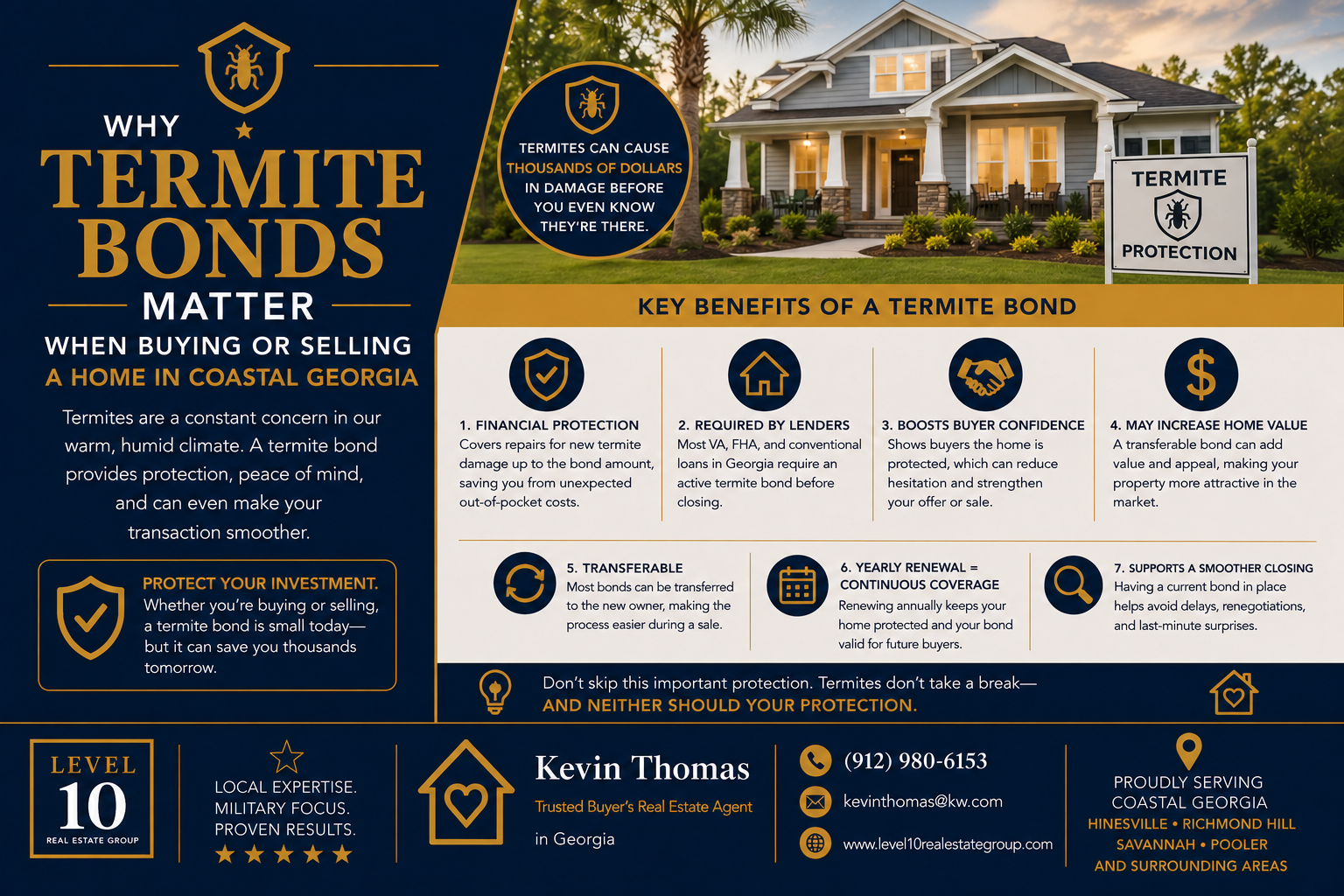
Written by Kevin Thomas
Termite bonds come up in nearly every Coastal Georgia real estate transaction, but most buyers and sellers only have a surface-level understanding of what they actually cover, what state law requires, and who's supposed to pay for what. In a region with this much termite pressure, that gap in understanding is exactly where transactions get delayed or buyers get surprised after closing.
👉 A termite bond is a service contract, not insurance — and Georgia has its own official, state-regulated inspection report that only licensed pest control operators can issue. Knowing the difference between bond types matters just as much as having a bond at all.
Here's what buyers and sellers both need to understand.
What a Termite Bond Actually Is
A termite bond is a renewable service contract with a licensed pest control company, not an insurance policy in the traditional sense. It obligates the company to retreat the property if termite activity returns, and — depending on the bond type — may also cover repair costs for new damage that occurs while the bond is active. It does not cover pre-existing damage discovered after the fact, and it isn't a substitute for a full inspection at the time of purchase.
The Official Georgia Wood Infestation Inspection Report
Georgia doesn't rely on a generic pest inspection for real estate transactions — the state has its own standardized document: the Official Georgia Wood Infestation Inspection Report, Form GDACS-9, regulated by the Georgia Department of Agriculture's Structural Pest Control Division.
Only a licensee holding a valid Georgia Structural Pest Control license can issue this report. It documents visible evidence of active or previous wood-destroying organism activity, includes a diagram of the structure showing any evidence found, and — critically — comes with a 90-day guarantee from the date of inspection.
Transferability isn't automatic. The report can be made transferable to a subsequent owner upon payment of a fee before its expiration date, or it can be issued as non-transferable — this is a specific choice made at the time the report is completed, not a default you can assume applies.
Two Types of Bonds: Know the Difference
This distinction matters more than most buyers realize when they're comparing what a seller is offering to transfer:
Treatment-and-repair bonds cover both retreatment and the cost of repairing new damage that occurs while the bond is in force. This is the more comprehensive — and more expensive — option, and it transfers with real financial protection intact.
Treatment-only (inspection-only) bonds cover retreatment if termites return, but do not cover repair costs for any resulting damage. These are less expensive to maintain, but they leave a real coverage gap that a buyer inheriting the bond needs to understand clearly before assuming they're fully protected.
Always ask which type of bond is in place — a bond that "transfers" doesn't tell you anything about what it actually covers until you know which category it falls into.
Why This Matters More in Georgia Than Most States
Georgia's humid climate makes it one of the most termite-active states in the country, and parts of Coastal Georgia's higher-humidity zones have also seen activity from Formosan termites, a more aggressive subterranean species. This is exactly why an active, well-documented termite bond isn't a formality here the way it might be treated in a drier climate — it's a real, ongoing line of defense against a genuinely persistent regional risk.
For Buyers: What to Verify Before Closing
Confirm whether the current bond is transferable, and get the transfer terms and fee in writing rather than assuming it carries over automatically.
Find out which type of bond it is — treatment-and-repair or treatment-only — so you know exactly what protection you're inheriting.
Check the inspection report's date and 90-day guarantee window relative to your closing date, since a report issued too far in advance of closing may need to be refreshed.
Ask about the property's termite treatment history, not just its current bond status — prior treatments and any documented past damage are worth understanding fully before you close.
For Sellers: Why an Active, Transferable Bond Is a Real Selling Point
An active, transferable, well-documented termite bond removes a friction point before it ever becomes one. Buyers and their agents specifically look for this in a region where it's expected, and a lapsed or non-transferable bond is one of the more common items that slows down a Georgia closing while it gets resolved.
Maintaining your bond and being ready to transfer it smoothly is a straightforward way to keep your closing timeline intact and avoid last-minute treatment costs eating into your proceeds at the worst possible moment in the transaction.
Who Pays: Customary Practice, Not a Fixed Rule
Termite inspection and bond costs are negotiable in every Georgia transaction — there's no law dictating who pays. That said, sellers customarily cover the cost of the WDO inspection report as part of closing costs, and transfer fee responsibility varies by transaction — sometimes the seller absorbs it to keep the deal moving, sometimes it's negotiated to the buyer. Clarify this specifically in your contract rather than assuming either party's default expectation matches the other's.
What Happens If Active Infestation Is Found
If the WDO inspection turns up active infestation or damage, it typically has to be treated and documented before closing — this is one of the more common items that can hold up a VA appraisal or a standard closing timeline alike. Sellers who address this proactively, before listing, avoid the scramble; buyers who catch it during due diligence have real negotiating leverage to have it resolved before they're locked into closing.
Why Work With Kevin Thomas
Knowing exactly what a termite bond covers — and confirming it's actually transferable before you rely on it — protects both buyers and sellers from a surprise that's entirely avoidable with the right questions asked early. Kevin Thomas is a trusted buyer's agent and marketing strategist serving Coastal Georgia, with deep experience helping military families, first-time buyers, and sellers navigate termite bonds, WDO reports, and everything in between throughout Hinesville, Richmond Hill, Savannah, and the surrounding region.
Working with Kevin means:
✔️ Clear verification of bond type and transferability before you rely on either ✔️ Guidance on Georgia's Official Wood Infestation Inspection Report and what it actually documents ✔️ Negotiation support on who covers inspection and transfer costs ✔️ Straight answers if active infestation or damage is found during due diligence ✔️ An advocate who treats termite protection as a real transaction detail, not a box to check
Your Next Step
Call or text Kevin Thomas: (912) 980-6153 Whether you're buying or selling in Coastal Georgia, make sure your termite bond is doing what you think it's doing.
Kevin Thomas with Level 10 Real Estate Group helps Coastal Georgia buyers and sellers get termite protection right — not just checked off.

Karyn Thomas
Lead Listing Agent/ Co-Team Owner | Level 10 Real Estate Group | Keller Williams Coastal Area Partners
or another way